Tuesday, February 9, 2010 – West Oakland Beat
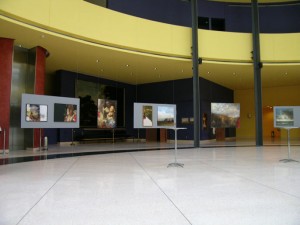
“The Prince Street House,” located on Prince Street in Berkeley’s south end, is filled with messy-hair-sporting, big-glasses-wearing, thrift-store-junkie type kids drinking cheap wine. Milling around the collection of paintings, photographs and other mixed media, Anthony Fonda instructs the crowd to go ahead and listen to that music on the Ipod nailed to the wall. It works and yes, it’s art.
Fonda, an eccentric local artist from West Oakland, was showing at the Prince Street House art show Saturday night along with many other local artists. Fonda, with his piercing black eyes and the wild hand gestures he threw while speaking about just about anything, stood out amongst the other artists by his palpable passion for creating. Desiree Dedolce, who has known Fonda since he moved to Oakland two years ago, gushes of the passion Fonda feels for things in his life. “He goes 100 percent for whatever he wants. He just manifests things, I wish I had that trait,” says Dedolce.
 West Oakland Beat
Fonda, 24, originally from Santa Monica, California, moved up to the Bay Area in August 2007 to escape the dead-end road he was traveling on. “I just worked two sh–ty jobs in restaurants, making no money and unable to make art from the hours,” said Fonda. “I just packed up and left trying to find an environment I fit into better.” He could not have found a better place. Fonda lives in the Vulcan Lofts on West Oakland’s San Leandro Street. These lofts and others located in West Oakland’s warehouses are a popular place for young artists to take over.
Although Fonda says there is no “real apex” for the art scene in the East Bay, West Oakland seems to be one of them. The cheap rent and relative freedom an artist has to do what he or she wants with the property keeps the art scene strong in this part of Oakland. Young artists are able to live in the many warehouse lofts for rent hovering around $100 to $200 a person, if they decided to live with others. Artists from West Oakland, and other parts of the Bay Area, will get together and hold events to showcase their budding talents. Interdisciplinary shows are mostly on the bill, which include an assortment of different media, music, painting, collage, performance art, and interactive art.
Fonda’s passion for art crosses many mediums, but his main focus is paint and collage. At the recent art show at “The Prince Street House,” Fonda showcased two huge oil paint portraits of a pelican and a zebra. Both, though dull in color mostly, had such detail and layering it looked as if the animals were alive within the canvas. Swapping is a main factor Fonda focuses on in his interview. He speaks often of the “art world” and those who inhabit it with such distaste. “I’m into swaps because artists don’t have a bunch of money,” says Fonda. “The art world is full of elitists who use money to buy creativity, galleries are full of garbage.”
“People like to buy into that sh-t, the art scene, young people scene. It’s all about appealing to someone,” said Fonda. Where does school fall into place with these kids, and even Fonda? Many of the young artists have been to some form of instruction yet most drop out after a few years. Elise Mahan, an art history major at San Francisco State University, says she can see where the mindset of these kids comes from. “I think they see art as an extension of themselves and not necessarily as a career,” says Mahan, “When they are in school they feel like it is as if they are working towards a career, that takes the passion out of it, makes it mechanical.” It’s not something Fonda has a choice in either. When asked if he ever thought about quitting art he said, “it’s not something you quit, it’s not an occupation.” Fonda’s philosophy on life seems very Marxist in nature. The swapping of goods according to one’s ability, the communal living and the freedom of “chance operations” would suggest this.
Fonda hopes to perpetuate the environment he so craves and to keep the creative spirit alive in his neighborhood of Oakland. A steady art space and “maybe” an art buyer, someone to commission and sell his art for him, are two of his main dreams. “I want a place where kids can come and just create,” says Fonda, “ trade pieces, just keep the flow of creative ideas out there.” Every hello is triumphant, every good bye a heartbreak with Fonda. In his usual dominant manner he exclaims, “Here’s your theme, I’m looking to be successful as an anti-academic, which will probably fail, but I have a lot of fun.”
Posted by Jocie at 2:33 PM
written by admin
\\ tags: Achievements, Art, Blogs, West Coast
BmoreArt is dedicated to showcasing and reviewing the visual arts in Baltimore.
Thursday, January 21, 2010
Recent Works at the John Fonda Gallery Friday, January 29
Opening Reception: Friday, January 29, 6-8 p.m.
John Fonda Gallery
45 West Preston Street
Baltimore, MD 21201
Located at Theatre Project
Hours: M-F Noon-4 p.m. or by appointment
written by admin
\\ tags: Achievements, Arts, Baltimore, Gallery
 Embassy of Italy - Washington DC - June 2007
(a past event… for the archives) The Embassy of Italy and the Italian Cultural Institute are cosponsoring an exhibition of artwork entitled “Lorenzo Fonda. A Retrospective.” The exhibit will be on display at the Italian Embassy until July 6, 2007. Maestro Fonda was born in Piran, Istria, in the former Yugoslavia in 1947. His family later moved to Trieste. He received a doctoral degree in medicine and surgery in 1976. His first personal show took place at the gallery “La Luna” in Perugia in 1969.
In 1984 Fonda had his first show in the United States at Andreas Galleries, in Washington D.C. His large canvas work “Trittico per la Pace” (1985) was presented to the town of Assisi, and is now permanently exhibited in the Sala della Conciliazione in Assisi’s Town Hall. In 1989, on the occasion of the USA / USSR Summit “Green Glasnost,” organized by actor Robert Redford, in Sundance, Utah, a large work of his became the symbol of that historical encounter. The work is now on display at the Institute for Resource Management. One of Fonda’s works is part of the permanent collection of the Michetti Museum in Francavilla al Mare, Italy. He has worked as set designer for Shakespeare in Jazz, with the direction of Giorgio Albertazzi, and, most recently, for the Teatro dell’Opera of Rome’s production of Richard Strauss Salomé.
written by admin
\\ tags: Achievements, Art, Events
 Ten Things I Have Learned About The Sea
Sunday, June 21, 2009 via No Zap
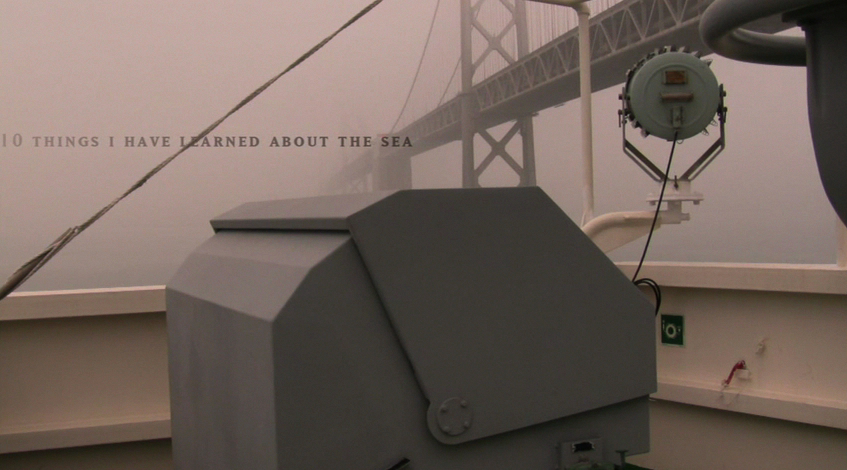
Italy – I crossed the Atlantic one a ship a few years ago and after it I knew I wasn’t the same anymore. Director Lorenzo Fonda has also felt the powerful insights that only the ocean can reveal, and in his beautiful short film “Ten Things I Have Learned About The Sea” he details them.
The visuals are stunning – a sort of transcendent combo of nature and the ships man has built to traverse across it. The industrial symmetry and mechanical serenity in the work of photographer Edward Burtynsky.
I also have to give props to Fonda for saying under the film “it is 104 mb, there’s no low res version and it is 10 minutes long. let it load. if you don’t have patience or don’t know me personally, you might not want to watch this.” The confidence of that speaks for itself.
Click here to watch “Ten Things I Have Learned About The Sea.”
written by admin
\\ tags: Art, News
This new Pilsen spot is a feast for the eyes, even if the kitchen needs more rehearsal time
Metromix.com May 13, 2009 By M. Kathleen Pratt
Ristorante Al Teatro
Address: 1227 W. 18th St., Chicago, IL, 60608
Phone: 312-784-9100
Hours: 4-10 p.m. Sunday-Thursday; 4-11 p.m. Friday-Saturday
Week-old Pilsen spot Ristorante Al Teatro offers a full bill. There’s food, sure. But chef Maurizio Fonda‘s Italian fare is just part of the show. The other part, the lavish space in which it’s served, is a feast for the eyes.
 In the Kitchen at Ristorante Al Teatro
The grand, 200-seat restaurant occupies the ground floor of Thalia Hall, the corner building that lords over the intersection of 18th and Allport Streets. The hall, named for the Greek muse of comedy and idyllic poetry, houses apartments on the upper levels, as well as retail spaces that are still undergoing renovations and an interior theater, the restaurant’s namesake, that’s next in line for restoration. Originally completed about the time of the World’s Columbian Exposition, the building earned city landmark designation nearly a century later, in 1989. But it was abandoned and in disrepair until late 2004, when restoration efforts began.
Though the building is late 19th Century, the ornate interior has been transformed into something almost Baroque. The restaurant has a larger-than-life feel, with four airy rooms spread out over two floors. There’s hardly an inch that’s not gilded, covered in some sort of polished stone or painted with trompe l’oeil curtains and arches. With its beautifully restored tin ceiling, fleur-de-lis patterned upholstery and other generally over-the-top embellishments (did we mention the downstairs waterfall?), there’s nowhere quite like it in the city.
Tucked away in the back of the ground-level dining room are two wood-fired pizza ovens where pizzaiolos toil under the watchful eye of a larger-than-life mural of Thalia herself. In any other restaurant, the brick ovens would be a focal point. Here, they’re just another piece of eye candy vying for your attention. But to overlook them would be a mistake.
Servers ferry the pizzas ($11.95-$14.95) from oven to table in seconds so they arrive still steaming, flame-kissed around the edges with a chewy crust and slightly wet center. As if taking a cue from the decor, the pizza menu covers a lot of ground, listing 20 options, from the house specialty pizza al galletto (roasted dark-meat chicken, sun-dried tomatoes, house-made pesto, goat cheese and mozzarella) to classics such as margherita, quattro fromaggi and pepperoni.
House-made pastas are a solid bet too, with options such as gnocchi al fromaggi ($13.95), soft, chewy pasta pillows in a rich five-cheese sauce, and rustic, mushroom-filled tortelloni alla boscaiola ($14.95).
Starting with our antipasto order-too-briny Mediterranean mussels in a savory white wine, herb and tomato broth-almost everything more nuanced than pizza or pasta went astray. Veal scaloppine ($21.95) was so overpowered by tart lemon juice that we could only manage a couple of bites before puckering up-and eventually giving up. Grigliata di calamari al limon ($14.95) suffered the opposite fate, though not to the same extreme. The grilled calamari had a divine smoky char but lacked the bright citrus notes needed for balance.
Ristorante Al Teatro owner Dominick Geraci also owns Caffe Gelato in Wicker Park, and the artisan gelati ($3.99 to go, $5.95 dine-in), available in two dozen flavors, are every bit as rich and silky as you’d expect. Other desserts, including wonderful house-made, chocolate-dipped cannoli ($7.95), are just as good. Most are available for carryout from the front gelato bar-which is perhaps your best option while Ristorante Al Teatro takes a little more time to rehearse its main act.
M. Kathleen Pratt is the Metromix dining producer. kpratt@tribune.com
written by admin
\\ tags: Chicago, Dining, Entertainment, News
|