Jan 25

BmoreArt

BmoreArt is dedicated to showcasing and reviewing the visual arts in Baltimore.

Thursday, January 21, 2010
Recent Works at the John Fonda Gallery Friday, January 29

www.leahcooper.com

www.juliebenoit.com

Opening Reception: Friday, January 29, 6-8 p.m.
John Fonda Gallery
45 West Preston Street
Baltimore, MD 21201
Located at Theatre Project
Hours: M-F Noon-4 p.m. or by appointment

written by admin \\ tags: , , ,

Jan 25

Faith & Finance: A Boom in Religious Funds

SmartMoney Magazine by Daren Fonda, Published December 22, 2009

What if Jesus were a stock picker?

It’s a question more investors seem to be asking these days. At a time when investors’ confidence in the markets has been shaken—even after the big rally of 2009—experts say a growing number of Americans are integrating their faith with their finances. The number of religious mutual funds has tripled over the past decade, to more than 90—with one now available for almost every flock, from evangelical Christians to Mennonites and Muslims.

Religious funds now control more than $27 billion in assets, up from $10 billion in the late 1990s, making it one of the hottest sectors in the broader category of socially responsible funds. “People are waking up and saying, ‘What I do with my money ought to reflect my values,’” says David Miller, a scholar at Princeton University’s Center for the Study of Religion.

Socially responsible funds have been around for years, of course, attracting both diehard followers and critics who see their stock-screening methods as a drag on returns. But the faith-fund boom is part of a growing hunger among religious people for financial guidance. While some financial planners specialize in estate planning and others claim an expertise in taxes, more and more are claiming the label of Christian financial adviser. Churches are also getting into the act, setting up workshops that dispense financial advice. And just this month, five new religion-based exchange traded funds were launched.

While most mutual fund managers place a laser-like focus on financial measures such as earnings per share and balance-sheet debt, managers of faith-based funds first check whether they think a company violates scriptural teachings. But injecting morals into financing is not without its share of controversy. Catholic funds typically draw a line at companies they believe support abortion or contraception; the evangelical Timothy Plan bans stocks of companies deemed supportive of a “gay lifestyle.”

Personal beliefs aside, each fund’s interpretation of scripture is open to criticism. “Why single out companies that provide same-sex benefits when they also provide benefits to employees who are greedy or venal or in other ways immoral according to biblical teaching?” asks Gary Moore, an investment adviser and founder of the nonprofit Financial Seminary in Sarasota, Fla.

Of course, just because a fund claims to have God on its side doesn’t mean investors will be blessed with top returns. Diversified U.S. religious stock funds are up an annual average of 2.27 percent over the past five years, just below the 2.34 percent return for all diversified equity funds, according to Morningstar. Religious funds tend to have expenses above the industry average, and because they often screen out certain sectors, they can be handcuffed when market sentiment shifts to an industry they’ve excluded. To find the best options, we looked for funds with solid long-term records and managers who have been at the helm for at least three years. (more at site)

written by admin \\ tags: , ,

Dec 25

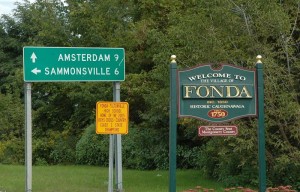
Fonda set to create Village Web site

Fonda-Signs

Entering Village of Fonda from West Rt 5

LeaderHerald.com POSTED: December 17, 2009

FONDA – The Village Board unanimously approved a motion Monday to launch the village into cyperspace.

The trustees voted to contract with Digital Towpath, a government entity formed through municipal agreements that specializes in developing Web sites for smaller municipalities across New York state. Officials expect to have the site up and running within a few months, and it will help get residents and businesses more involved and informed.

“It’s better for the village to have a Web site so potential prospects who want to start businesses will have a way to get in touch with us,” Trustee Robert Galusha said.

The annual contract with Digital Towpath is not yet finalized. The village will pay about $600 a year for the service and will need no additional staff to maintain the Web site. The annual fee will include technical support for the system and phone and e-mail support for the software.

Fonda-MainSt

Fonda Main Intersection of Rt 5 and Rt 30A

“It’s a Web-based application and we provide access to the tools,” Digital Towpath Director Jeanne Brown said Tuesday. “Each municipality is responsible for the content on their site, and they don’t need technical knowedge. They just need to know how to use a word processer and open a browser to keep the site updated.”

Officials plan to use the site to post meeting times and minutes and an event calendar. Trustee Lynn Dumar said she hopes the site will have a feature that encourages taxpayers to ask questions of their elected officials. A newsletter published twice a year is the only village-sponsored information medium currently available.

“This will make people more aware of what’s going on and open more doors,” Mayor Kim Flander said.

Digitial Towpath powers several local municipalities’ Web sites, including the town of Johnstown, village of Canjoharie and town of Mayfield.

Headquartered in Syracuse, Digital Towpath went live with its first 10 municipal Web sites in 2000. In 2005, participating municipalities signed the agreement that formed the Digital Towpath Cooperative.

The village is not required to join the cooperative, but if it does, it will have a say in software changes, cost and the level of training included in the annual fee. Digital Towpath’s day-to-day operations are funded by annual fees.

Amanda Whistle covers Montgomery County. She can be reached at montco@leaderherald.com.

written by admin \\ tags: , ,

Nov 08

Bright Idea: The Compact Fluorescent Light Bulb

From the April 2008 Conservationist
By Shannon Brescher Shea

Since its creation by Thomas Edison in Menlo Park, New Jersey in 1879, the light bulb has undergone a number of changes. Many of the innovations that make the incandescent bulb what it is today came out of General Electric’s laboratory in Schenectady, New York.

Dr. Gorton R. Fonda scientist for General Electric Laboratory in Schenectady, NY

Dr. Gorton R. Fonda (1884-1973) scientist for General Electric Laboratory in Schenectady, NY

The first major advance was crafting a tungsten filament, the wire the electricity heats to create light. When Edison first invented the bulb, he used a carbon filament which has a much shorter lifespan than tungsten. Although others attempted to make the thread out of tungsten, they found it too brittle to mold into the needed shape. However, working in the Schenectady laboratory, Dr. William Coolidge discovered how to increase the wire’s flexibility in 1909. To this day, manufacturers continue to use tungsten in incandescent lights.

Dr. Irving Langmuir, another scientist in Schenectady and a Nobel Prize-winner, made two other major discoveries. A significant problem with light bulbs was that they blackened as the filament burned, decreasing the amount of light produced over time. In 1912, Langmuir realized that if you filled the bulbs with a neon-like gas, you could prevent this effect. He also developed the technique of coiling the filament, which doubled the bulb’s lifespan.

In addition to incandescent bulbs, the Schenectady laboratory also played a role in the development of the compact fluorescent light bulb. Although the “spiral” fluorescent was officially invented in an Ohio General Electric laboratory by engineer Ed Hammer, Dr. Gorton Fonda** in Schenectady played a key cooperative role in its development. Unfortunately, when it was created in 1976, the company decided it would be too expensive to mass produce. Thanks to modern technology, fluorescent bulbs are now both economically and environmentally smart.

Chris Hunter, Director of Archives and Collections at the Schenectady Museum & Suits-Bueche Planetarium, provided the historical background for this article.

**For info on Dr. Gorton R. Fonda, see rootsweb and findagrave listings.

written by admin \\ tags: , , ,

Nov 08

Lightning Strikes – Suffolk County

Hudson River

Hudson River

From the August 2007 Conservationist
By Lt. Ken Didion

ECOs Vernon Fonda and Jason Curinga were checking fishermen at a popular spot in Shoreham as a thunderstorm approached. The officers had separated in order to complete their checks before the storm arrived. ECO (Environmental Conservation Officer) Fonda was talking with a fisherman when a person ran toward him screaming for help. ECO Fonda ran to where he saw a woman lying on the ground. The womans family members said she had been standing in the water when lightning struck nearby. A quick check revealed that the woman was not breathing and did not have a pulse. Officer Fonda immediately began CPR and the woman began to breathe on her own. When ECO Curinga arrived to assist, the woman lost her pulse and ceased breathing again. ECO Fonda resumed CPR, assisted by an EMT who had just arrived. The two rescuers revived the woman, and she was transported by helicopter to Stony Brook Hospital.

written by admin \\ tags: , ,