Business, 24 Jul 2017 / By Sta
Lucija – The Fonda fish farm has managed to expand as well as preserve its strategy and jobs since being joined by an Italian strategic owner a year ago. The family-run business, which specialises in breeding top-quality sea bass, partnered with Vale Ca’ Zuliani from Ravena a year ago in order to keep the business running. “The mood is very positive. We’ve kept all the jobs, our company’s strategy,” the director Irena Fonda has told the STA, also praising good two-way cooperation in transfer of know-how.
The fish farm employs 18 people plus seasonal workers. The Italian partner has let them preserve their quality-based direction and approach in the supply of customers. “We have broader shoulders than we used to have,” says Fonda, adding that they have managed to expand the farm capacity after initially failing to get the support from a creditor bank. Despite the red figures at the moment owing to the fact that the fish is not big enough to be sold yet, the cash flow is encouraging, she said.
The farm focuses on quality rather than quantity, aiming to sell most of the bass locally. The fish quality increases the further north you go in the Adriatic, and “we are the northern-most fish farm in the Adriatic”. At first they sold virtually all of their fish abroad, while 13 years since launching the business and ten years under the Fonda brand, most of the fish is sold in Slovenia, and increasingly many to Austria. An important factor has been education of customers through guided tours of the fish farm. “People come here, have a good time for an hour, while they also learn quite a lot.”
The director has noted a change in people’s mentality. As the start of their business, Slovenians ate 5.3 kilos of fish pert capita a year, a number that has doubled to ten kilos since. Still, the figures remain low when compared to more than 25 kilos in Italy and more than 44 kilos of fish per capita consumed in Spain. One of the farm’s plans is to place Slovenian fish on the menus at Slovenian schools and kindergartens. “Kids like good fish,” says Fonda, adding that one problem is public procurement rules.
By Kester Eddy, Financial Times, June 11, 2013
 Irena Fonda leans over the side of her boat and throws a handful of food pellets into the waters of the northern Adriatic. After a pause, the water is suddenly alive with fish, thrashing just below the surface. “They are not right today; they are normally waiting for the boat. It’s probably because of the storm,” Ms Fonda shouts above the wind. The boat is just inside the Slovenian waters of the Bay of Piran, in the northern Adriatic: ahead is an array of circular fish cages, up to 12m in diameter, holding around 1m sea bass that Ms Fonda and her brother raise from the age of seven months to five years. A few metres behind us is the maritime border with Croatia. Irena Fonda leans over the side of her boat and throws a handful of food pellets into the waters of the northern Adriatic. After a pause, the water is suddenly alive with fish, thrashing just below the surface. “They are not right today; they are normally waiting for the boat. It’s probably because of the storm,” Ms Fonda shouts above the wind. The boat is just inside the Slovenian waters of the Bay of Piran, in the northern Adriatic: ahead is an array of circular fish cages, up to 12m in diameter, holding around 1m sea bass that Ms Fonda and her brother raise from the age of seven months to five years. A few metres behind us is the maritime border with Croatia.
There are scores of aquaculture – fish farm – operations in the Mediterranean, but none quite like the Fonda Piran Sea Bass farm, which is small, currently yielding a mere 50 tonnes of fish annually. The industry benchmark for profitability is five times that, and farms in Greece and Turkey are typically 500-1,000 tonnes or more.
 Fishing for profit: Ugo Fonda applied his expertise in marine biology to fish farming. After his death, the company has continued to be run by his daughter Irena and her brother Lean, both biologists The Fondas, Irena and brother Lean, are biologists, who – with their now deceased father – in 2001 took the profits from their underwater engineering business and turned their scientific minds to producing a better-quality, healthier sea bass than those of the large commercial farms.
To prove the point, Ms Fonda points to the depths. “You see, the nets are overgrown with algae. Most farms use antifouling agents, but these are bad for nature and I’m sure it’s bad for the fish,” she says.
But eschewing chemical methods means using divers to clean the nets manually, a time-consuming, expensive process. Nonetheless, the Fondas apply this ethos to every aspect of the operation, from identifying the highest-quality fingerlings – juvenile fish – bought from hatcheries in France and Italy, to sourcing the very best fish-food producers.
They also harvest the fish in supercooled brine – effectively putting them to sleep – to cause the least stress. The result is sea bass with a lean, tasty body that has been tested to reveal mercury levels at just 4 per cent of the legal limit. Despite prices of between €16 and €25 per kg at the farm shop – a 100 per cent premium over sea bass from large commercial farms – demand is outstripping supply. For good reason, says Curt-Daniel Scheffler, executive chef at the Kempinski Palace Hotel, in the nearby resort of Portoro.
“Irena Fonda presented her fish during the hotel’s pre-opening phase [in 2008]. I could see straight away that this was a very ambitious company, with a high-quality [product], very different from ‘factory fish’, with automatic feeding and chemical net treatment,” he says. Fonda sea bass has been on the Palace menu ever since. But widespread success was initially elusive. Ms Fonda admits that their original assumption – that the public would recognise and pay for high-quality fish – was extremely naive. “People just saw our fish was more expensive, and asked why. It was very disappointing,” she says.
 Irena and Lean Fonda amidst fish farm pools At first, almost the entire production went to Italy, which has a more discerning fish-loving public. But even with the higher prices achieved there, the operation was unsustainable. The team reviewed their strategy, selling via a newly created website, Web Store Fonda, guaranteeing the freshness of each fish with an individual tag, dating the catch. They also offered to deliver fish all over Slovenia in special boxes, packed with ice.
Almost overnight, a public that had shunned sea bass on the slab carrying a 20 per cent premium began changing its mind. Having won a string of domestic entrepreneurial awards for the Fondas’ efforts, the brand is now well established in Slovenia, which accounts for 70 per cent of sales. Yet the business still struggles. Despite official policies to encourage private enterprise, a project to double the size of the farm was delayed for three years by ministerial red tape. And the banks have tightened credit lines – a near-crippling blow to a business that needs four to five years’ investment before any return appears.
But as the Fondas’ fame spread, an increasing number of people asked to see the farm. “At first, we just welcomed visitors, but it began taking too much time. So we started charging, showing tourists the cages, feeding the fish, and then having a little degustation afterwards, with local wines and produce,” Ms Fonda says. Around 1,200 tourists last year brought in €40,000 – a small proportion of total farm revenues of €1m – but it needed no new investment. “We need three lorry loads of feed per month in summer, at about €30,000 a time. That has to be paid,” she says.
The Fondas have invested in new equipment and educational material, expecting to double numbers to about 2,500 visitors this year. But there are limits. “It’s a good way to add value to our brand, but we do not have the structures for mass tourism. We take each guest personally to the farm with the boat; it takes time,” she says.
 Lean, Ugo and Irena Fonda The Fonda family’s battles with bureaucracy, banks and even their own naivety in areas of business outside their expertise is a common enough experience for entrepreneurs in the former communist states of central and eastern Europe, says Andreas Antonopoulos, rector of the University of New York in Prague and professor of entrepreneurship.
Governments and ministries across the region struggle to understand entrepreneurs – that is if they care in the first place, Prof Antonopoulos told the Financial Times. “In my experience, [in the past] they did not really care, and now that the importance of entrepreneurship and what it results in for the local economies is starting to dawn on policy makers, they have limited understanding of how to help out,” he says.
There is much these governments can do to cut bureaucracy and ease excessive or sometimes contradictory regulations, he says. “The most obvious starting point for governments wanting to help is to stay out of the way, and facilitate entrepreneurs to spend all their energy on their ventures, ie cut red tape, taxation, complexity and bureaucracy, indeed, minimise interaction with the state. “They should try to see it from the entrepreneur’s point of view; estimate how much time, effort and money a new venture would need to spend on state-related tasks, and seek to minimise that cost,” Prof Antonopoulos adds.
Entrepreneurs are turned off by the amount of paperwork involved in seeking state subsidies, he says. “Monies are rarely put to genuine good use, although I’ve seen a couple of more promising schemes around.” The situation is slightly better in the western Visegrad Four states (Poland, Czech Republic, Slovakia and Poland), where entrepreneurs generally face fewer hurdles than further east, primarily due to the more politically and economically mature societies. “These countries have more developed domestic markets, somewhat easier access to capital and more advanced legal systems and start-up communities,” Prof Antonopoulos says.
written by admin
\\ tags: Business, Environmental, Italy
An MBA candidate created an organization to increase literacy in Uganda.
by Kimberly Burton, 20 September 2016
 St. Mugaga Secondary School library is one of the nine libraries the Literate Earth Project has opened throughout rural districts of Uganda since 2013, with two more openings slated for this year. During a service trip Jeff Fonda took to Uganda, he worked in a school with no textbooks. Instead, every student was given a hand-written version of a textbook for their classes. “It’s a crazy process, they actually hand copied each book over and over again,” Fonda said. “It was great they had the text, but they had no formalized pictures or graphs.”
Fonda, a first-year master’s of business administration student, was inspired by his experiences in Uganda to found the nonprofit called The Literate Earth Project, an organization that helps Ugandan children get access to books and increase literacy. Other than the hand-copied textbooks, students had no books to read for pleasure. Fonda soon discovered the school’s headmaster had approximately 15 books in his office and decided to show them to the students. “With these books and atlas, they were seeing pictures of new people, trees, buildings, things they had never seen before,” Fonda said.
Information about sports in particular were of interest to them, Fonda added. “They were asking things like, ‘What is this sport?’ They had never seen tennis before. ‘What is this racket for?’” he said. This is when his revelation occurred, he said. “You could see the wheels were going in their heads,” Fonda said. “That experience of seeing the real need for knowledge and how it spurred these other thoughts and conversations was amazing.”
 Ugandan Vice President Edward Ssekandi and LEP Founder Jeff Fonda The Literate Earth Project was officially formed in 2011. In 2013, Fonda and his organization opened their first library in Uganda. In that same year, they also received a LEAP grant from BetterWorldBooks. LEAP grants are given to organizations with “game-changing” ideas to “help advance a compelling literacy project,” according to its website. “We watched [the first library] for a year and half to see it’s successes and failures,” he said.
After Fonda and other individuals from the organization saw the library was working, they began to open more libraries throughout the country in 2014. In the past two and a half years, The Literate Earth Project has opened nine libraries in areas like the Rakai, Masaka and Wakiso districts of Uganda. The organization will also open two more this year. “As long as we are able to keep up funding, we’re actually on pace to open four to six libraries per year and we would like to continue at that pace,” said Alex Moore, project’s chief operating officer.
The need for books in Uganda is evident through the requests for the organization’s libraries. The Literate Earth Project has a list of about 50 schools that have been okayed to receive libraries, but hundreds have made requests. To ensure success, the organization has a vetting process where staff visit the school to assess its needs. They make sure the teachers and community are going to get involved, and that the books will actually be used by the students.
In the past, to raise awareness for the program, Fonda has met with Uganda’s Vice President, H. E. Edward Ssekandi. Ssekandi has implemented policy to aid in increasing literacy in Uganda. Fonda said he hopes to expand the program to the many schools on their waitlist, but the organization doesn’t have money for the books themselves. By applying for grants, starting college clubs and hosting events like the Let’s Get Literate 5K Run, they have started to raise more money for their efforts. “We’re constantly looking for new partnerships so that we can kind of work together with other organizations that might provide solar energy or computers to schools,” Moore said.
Fonda, who is interested in eventually starting a club on Main Campus connected to his nonprofit, hopes to continue focusing on Uganda due to the serious demand for libraries. “I’d like to say we can change the whole world, but right now our goal is to change Uganda,” Fonda said. “The demand is insatiable [there].”
Kimberly Burton can be reached at kimberly.burton@temple.edu.
Also see: Literate Earth Project, Books for Africa
written by admin
\\ tags: Achievements, Education, International
By Christi Boortz, Curriculum & Professional Development Department
Posted on December 16, 2015
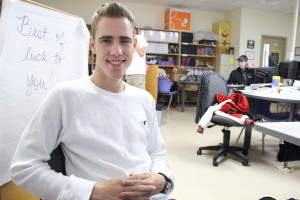 Blind and visually impaired high school students were excited when a new class showed up on the FSDB course schedule for the fall semester, among the usual listings. Technically “Journalism 1,” the class focuses on Yearbook Production, and is taught by English and Language Arts instructor Melissa Fonda. The class has a strong literacy component integrating technology and the visual arts. Students learn writing and listening skills, as well as the aesthetics of photography and layout design. They use email to schedule interviews, fact check, and submit assignments via computer. Also, they use the Memory Book website to upload photos and create copy and layouts. Fonda has many good memories from participating in yearbook production as a student back in her early years—she “enjoyed the technical and creative aspects of making layouts and writing features,” Fonda received state of the art technology and equipment to implement the class, in the form of a giant Apple screen display unit with wireless keyboard and mouse, and two high quality Canon cameras. The class is composed of juniors and seniors, which is just fine by Fonda since “older students have had time to develop their writing skills, they know who people in the high school are, and they have a sense of the extracurricular activities that everyone is engaged in – more maturity overall.” Fonda is also pleased with the cross section of students who signed on, which includes athletes, musicians, artists, and Student Council members. Initially six students signed up, but three more added the class after they heard it was fun. Word travels fast in BHS! Blind and visually impaired high school students were excited when a new class showed up on the FSDB course schedule for the fall semester, among the usual listings. Technically “Journalism 1,” the class focuses on Yearbook Production, and is taught by English and Language Arts instructor Melissa Fonda. The class has a strong literacy component integrating technology and the visual arts. Students learn writing and listening skills, as well as the aesthetics of photography and layout design. They use email to schedule interviews, fact check, and submit assignments via computer. Also, they use the Memory Book website to upload photos and create copy and layouts. Fonda has many good memories from participating in yearbook production as a student back in her early years—she “enjoyed the technical and creative aspects of making layouts and writing features,” Fonda received state of the art technology and equipment to implement the class, in the form of a giant Apple screen display unit with wireless keyboard and mouse, and two high quality Canon cameras. The class is composed of juniors and seniors, which is just fine by Fonda since “older students have had time to develop their writing skills, they know who people in the high school are, and they have a sense of the extracurricular activities that everyone is engaged in – more maturity overall.” Fonda is also pleased with the cross section of students who signed on, which includes athletes, musicians, artists, and Student Council members. Initially six students signed up, but three more added the class after they heard it was fun. Word travels fast in BHS!
Bryce Cothron plans to be a novelist in adulthood, so he especially enjoys writing snippets for the yearbook. He also expressed appreciation for learning about the various elements of photography, such as composition and positioning. He summed up, “It’s interesting to see how it all comes out. Good stuff.” Jonathan Moran asked himself, “Why not?” and showed up for class. He cites editing as one of his favorite activities. Ditto for student Aaliyah Gisondi, who loves being a copy editor. She admitted with a smile, “I get to tell anyone when they have made errors. It might sound funny but that makes me happy.” Gisondi also took the class so she could work with “Ms. Fonda,” one of her favorite BHS instructors. Roque Moran, brother to Johnathan, took the class partly because it fit his schedule and partly because he felt it would be interesting. The class has met his expectations. Among other things, he has learned “taking good pictures requires accuracy.” And he enthusiastically endorsed the instructor, saying “Ms. Fonda’s teaching is awesome.”
 Emmitt Johnson enjoys writing and “running around the school to take photos of events.” He has learned, in terms of formatting, what to do and what not to do. Nick Thompson favors design and layout, but explained that he additionally does “odd jobs, like getting photo permissions.” Vanessa Coleman had a professional take on the “soft skills” she has been learning through the course, stressing that one should “always follow up and stay on task.” She shared her former problems with procrastination and explained “As soon as you get a task to do, you better get on it right away!” Quinn Delong took the course on the advice of Assistant Principal Charlie Crozier. Delong already had some accumulated knowledge from working with Fonda on the yearbook last year. He feels the course has added to his skill set in media, from technical aspects of layout to the softer skills of working in teams effectively, and sharing knowledge with his classmates. He has some advice to offer: “Do what you love, love what you do.” Apple Polonia is the editor of the club section in the yearbook, and through an email interview, shared that she is learning cooperation and interviewing skills. She highly recommends the class as a good learning experience for those who enjoy design and communication. She suggests that her peers should “try as many different things as possible, because knows that thing might turn into an interest and then maybe a passion.” Emmitt Johnson enjoys writing and “running around the school to take photos of events.” He has learned, in terms of formatting, what to do and what not to do. Nick Thompson favors design and layout, but explained that he additionally does “odd jobs, like getting photo permissions.” Vanessa Coleman had a professional take on the “soft skills” she has been learning through the course, stressing that one should “always follow up and stay on task.” She shared her former problems with procrastination and explained “As soon as you get a task to do, you better get on it right away!” Quinn Delong took the course on the advice of Assistant Principal Charlie Crozier. Delong already had some accumulated knowledge from working with Fonda on the yearbook last year. He feels the course has added to his skill set in media, from technical aspects of layout to the softer skills of working in teams effectively, and sharing knowledge with his classmates. He has some advice to offer: “Do what you love, love what you do.” Apple Polonia is the editor of the club section in the yearbook, and through an email interview, shared that she is learning cooperation and interviewing skills. She highly recommends the class as a good learning experience for those who enjoy design and communication. She suggests that her peers should “try as many different things as possible, because knows that thing might turn into an interest and then maybe a passion.”
About FSDB
Florida School for the Deaf and the Blind (FSDB) is a fully accredited state public school and outreach center available tuition-free to eligible pre-K and K-12 deaf/hard of hearing and blind/visually impaired students. Comprehensive educational services at FSDB are individualized, specific to the unique communication and accessibility needs of each student for independence and lifelong success. FSDB gratefully accepts private donations to support vital programs that directly benefit students and are not paid by state general revenue funds. To visit the school or to learn more about eligibility for enrollment, contact 1-800-344-3732. For more information, visit www.fsdb.k12.fl.us.
written by admin
\\ tags: Achievements, Education, SouthEast
January 28, 2015 by The Hudsonian Student Newspaper – Andrea Currie, News Editor
 Mike Fonda, a retired Cohoes Police officer who specialized in sexual assault crimes, now does counseling at Hudson Valley once a week. “This is a perfect retirement job for a guy like me,” said Mike Fonda, a retired Detective Sergeant from the Cohoes Police Department, who works as a Prevention Educator for the Sexual Assault and Crime Victims Assistance Program (SACVAP) at Samaritan Hospital in Troy. Fonda’s work takes him all over the Capital Region: he teaches personal safety and self-esteem at K-12 schools; he conducts the Mentors in Violence Prevention (MVP) program at seven YMCAs; he offers the MVP program to sports teams at local colleges; he conducts the MVP program with inmates at Rensselaer County Jail; and on Wednesday afternoons from 12 – 4 p.m., he offers in-person counseling at the Hudson Valley Health Services office in room 146 of Fitzgibbons Hall.
When Fonda started working at the Cohoes Police Department, he was assigned the traditional role for incoming officers: juvenile officer. “You deal with everything from stolen bikes to the sex crimes,” he said. When a new person joined the department, Fonda asked to keep the job, and when he was promoted to sergeant, he requested to keep working on sex crimes. He said that he thought he had the right demeanor for the job. “I had other police officers come up to me and say, ‘you know, you’re relaxed, you’re fun, people feel safe with you, … they trust you. So I just stayed with it.’”
In 2007, Fonda was hired by the New York State Division of Criminal Justice Services to track down the records of sex offenders who moved in from out of state. There is no central repository for these files, so he had to speak with other police officers, agencies across the country, and, often, call sex offenders and interview them about their convictions. Fonda said that offenders often lied to him during these interviews. “I let them blame the victim. But in that victim-blaming is the truth,” he said, “I’ve learned to give people enough rope to hang themselves.”
Fonda briefly worked with SACVAP before joining the state and had stayed in contact with them. In early 2011, they told him they had a prevention educator position open. He jumped at the chance. “Sometimes money isn’t—you know. It’s okay, but I feel like I need to be doing something,” Fonda said. His state job was a good job and paid well. “But you’re basically in an office working with a fax machine, a telephone, and your computer.” He said the prevention educator position was a perfect fit for him, since he has a master’s degree in Community Psychology, has taken many counseling courses, and with his law enforcement background, can talk about the subject from experience. “I know there’s a lot of people out there wondering, did I do something wrong? Who’ll believe me? … Well, I would, ’cause I know. I’ve seen that, the cases with the state police and the Cub Scout leaders and the Kiwanis clubs,” said Fonda.
He said that his favorite part of his job is going out into schools and providing information. He said that he focuses on victim-blaming and why people shouldn’t blame themselves for being assaulted. “I’m hoping to see some lights go on with people saying, Okay, so it wasn’t just me,” said Fonda. Fonda said that the MVP program gives him an opportunity to address men. “These issues, they seem like they’re women’s issues, because you might say, women get raped,” he said, “But it’s men who rape women. And it’s not every guy who rapes a woman.” He says that the MVP program challenges men to speak out and condemn sexual assault. He speaks about men who’ve been sexually assaulted as well and reassures them that they did nothing wrong.
Fonda said that over the time he’s been doing this work, he has observed a change in public attitudes towards sexual assault and rape. “To me, it feels like it’s finally getting the attention it deserves,” he said, “It feels like we’re on a bubble, that all this stuff is about to burst and people are going to know about it, they’re going to understand it, and they’re not going to look at it the same way as … saying, I’m broken, or, it’s the victim’s fault, or … how can you accuse these celebrities of doing that?” Fonda said that sexual assault is never about sex: “It’s about the power. It’s about having that power to do what they want.”
Fonda said that he is proud of SACVAP. “It’s just phenomenal work. It’s not sexy, it’s not glamorous, people don’t want to talk about it, but every day, we’re there, 24 hours a day, seven days a week,” he said, referring to the agency’s sexual assault hotline. SACVAP offers in-person services at Samaritan Hospital at 2215 Burdett Ave. in Troy, including short-term counseling; therapy free of charge; and legal advocates for survivors.
The agency also has opportunities for volunteers. Winter 2015 Volunteer Training starts Feb. 3. Volunteers must be at least 18 years old and be willing to sign up for at least three hotline shifts monthly, commit to at least six months with the agency, attend monthly in-service meetings, and complete at least 10 hours of community education.
Interested parties should contact Jamie Seastrand by phone at 518-271-3140 or via email at jamie.seastrand@sphp.com.
written by admin
\\ tags: Albany Co., Law Enforcement, Municipal
 Personal Liberty, Posted on June 17, 2015 by John Myers Personal Liberty, Posted on June 17, 2015 by John Myers
Actress Jane Fonda is still raking in money despite the fact she has been ridden hard and put away wet. The 77-year-old is now featured in the Netflix comedy “Grace and Frankie” — the very same Hanoi Jane who was making the lives worse for Americans fighting for their life in the jungles of Vietnam 45 years ago.
Last Saturday, Fonda was not far from my neck of the woods. She spoke in Vancouver, Canada, at a Greenpeace Canada rally, Toast the Coast. It was launched to demonstrate against oil sands development, tanker traffic and future Arctic oil drilling.
Fonda said: “I feel totally committed with every ounce of my being to stopping Big Oil from doing what they’re doing — both drilling in the Arctic and piping tar sand oil across the land into this coast, which is so pristine.”
I cannot figure out Fonda’s economic platform. But it seems to highlight North American energy insecurity, future gas lines and sky-high oil prices that will be dictated by the Middle East oil producers, like Saudi Arabia, which quietly finance the world’s worst jihadists. It is only logical because shutting down Arctic exploration and stopping the transportation of Canadian oil along the West Coast would be dangerous geopolitically for the United States and would throw the county further toward energy instability while creating a massive recession for energy workers.
In her 1995 book “My Life So Far,” Fonda complained about ex-husbands Ted Turner and Roger Vadim. She wrote that Vadim dominated her and made her have threesomes with him and other women. All this suffering, and today she is down to her last $120 million. I doubt Fonda has ever been worth much less than $5 million and has lived only in mansions and driven only gas-guzzlers. I’ll bet she doesn’t have the least understanding what Americans need in a job.
Fonda never had to worry whether her famous actor father was going to make enough money to keep the family going. I am certain that as she marches toward age 80 while continuing her social protests, she has zero understanding of how critical North American oil is to the United States as a nation and to the people who need those jobs.
Green Jane is still the one and same Hanoi Jane who made radio broadcasts to discourage drafted American GI’s, who were already hurting and fighting in a war just to stay alive. Yet she was a willing, attractive and, some may even say, convincing actress in her peacenik patronage of North Vietnam, including having her picture taken manning an anti-aircraft battery whose sole purpose was to shoot down American flyers.
Mr. Conservative stated:
What Jane Fonda did was traitorous. In fact, it’s a shame that she that she got away with committing treason because it made some of her fellow travelers on the Left realize that there is no price to be paid for encouraging people to hate their own country.
Unfortunately for Fonda, there are still a lot of Americans who love their country and they haven’t forgotten or forgiven her for betraying it.
So, periodically, Fonda gives insincere apologies for her despicable actions.
Here’s the latest one that she gave to Oprah Winfrey.
“I made one unforgivable mistake when I was in North Vietnam, and I will go to my grave with this. I don’t know if I was set up or not,” she said. “I was an adult. I take responsibility for my actions. And I was laughing and clapping, and there were pictures taken.”
She was “laughing and clapping” while Americans were dying. She was “laughing and clapping” while Americans were rotting away in POW camps. She was “laughing and clapping” with her new pals who she knew were torturing American soldiers.
Given the fight Fonda now has against North American oil discovery and transportation, she has once again aided and abetted the enemy: Islamic oil producers.
And while President Barack Obama may insist that Saudi Arabia is one of America’s closest allies, he and his fervent liberal and ultra-rich followers should pay attention to the fact that high-ranking members in the Saudi government carried out 9/11 with Saudi agents. But 14 years later, Saudi Arabia still dictates the price of world crude oil.
With oil prices just over half of what they fetched a year ago, domestic oil discovery, production and transportation industries are in a depression. Poor families up and down the west coast are trying desperately to hang on to jobs in an industry that was expected to be a major power source to the United States for the next several decades.
It seems Jihadi Jane neither understands how her actions are viewed by the enemy (major Muslim oil exporters, some of whose core members want to see the destruction of the United States) nor how these anti-jobs protests impact hundreds of thousands of North American families.
That North American oil can be competitively and safely produced doesn’t seem to be a thought that runs through Fonda’s head. Nor does she seem to understand that people’s biggest problems aren’t orgies and drug parties with former husbands but rather just keeping food on the table for the kids and a furnace going.
Fonda will never admit she doesn’t understand the working class — just as another pro-feminist, anti-Vietnam war female contemporary will never make that admission: Hillary Clinton, who is making her second bid for the U.S. presidency.
While Fonda was spending her time on the west coast Friday protesting oil, Clinton was launching her campaign across the country on New York City’s Roosevelt Island. She spoke to the audience about how she knew of tough times because her parents went through the Great Depression. Fonda knows how hard it was just to stay alive during the Dust Bowl because her father gave an outstanding performance in the much acclaimed 1940 movie “The Grapes of Wrath.”
Over the years, my dad told me how at 12 he was driving a wagon team with a team of eight horses across the prairie, sometimes to be caught up in a winter blizzard or deterred by a lame horse. His stories made me shiver. But despite the fact he had done it, I didn’t have the slightest clue as to how such an endeavor would even begin.
Fonda seems to believe that playing a starring role in the movie “The China Syndrome” makes her an expert on energy policy. Another aged hippie, Clinton, told us that same day that she understands tough times for the working class because her parents went through the Depression. I guarantee neither have faced tough times nor were worried where their next meal was coming from.
Clinton may do far more damage to the country if elected president, but both women make promises that they have no intention of keeping. The winner for tease of the month is Fonda for what she told The Vancouver Sun:
If I have to tie myself to some rig or if I have to lie down in front of a truck, I’ll do it. I’ve lived a good life. I’m willing to do that.
I, too, am willing for her to do the right thing rather than flying around the world in Gulfstream private jets, protesting the very crude oil that keeps her aloft. And as far as I am concerned, it wouldn’t do any great harm to America for Fonda to take Clinton down with her.
Yours in good times and bad,
–John Myers
written by admin
\\ tags: Achievements, Fonda Family, Hollywood
|

