
William Clark Fonda (1858–1938), better known as “Skagway Bill,” traveled from New York’s Mohawk Valley to the gold fields of Alaska and the Yukon. He became a familiar figure among northern pioneers, a teller of frontier stories, and—most remarkably—the model for a monumental bronze prospector that still stands in Sitka, Alaska.
From the Mohawk Valley to Alaska
Born January 25, 1858, in Montgomery County, New York, William was the son of Peter Jacob Fonda and Catherine Huguenin Fonda. Known as “Clark” in at least one contemporary pioneer publication, he spent his early years around Glen, Fultonville, and Fonda. A 1938 hometown obituary remembered that he helped his father, an Erie Canal boatman, before setting out on his own adventures. His sister was Cora A. Fonda Phillips; his sons were John and Edward.
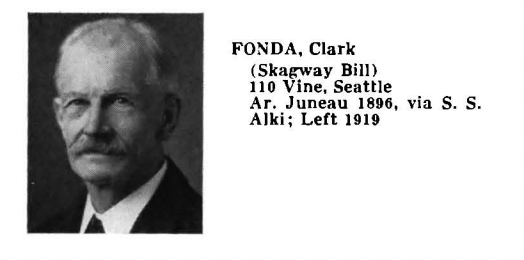
An especially valuable record appears in The Alaska-Yukon Gold Book (1930), published by the Sourdough Stampede Association. Beside his portrait, the entry identifies “FONDA, Clark (Skagway Bill),” gives his Seattle address as 110 Vine Street, and records an arrival at Juneau in 1896 aboard the steamship Alki, followed by “Left 1919.” Other accounts give 1892 or 1897 for his arrival in Alaska. These differences may reflect more than one journey north, but the precise chronology is still being investigated.
Adventures in Gold Country
A Johnstown newspaper reported in August 1897 that William C. Fonda had reached Tacoma while traveling toward the Klondike, full of hopes for gold. A July 1900 item in the Troy Daily Times reported that he had sold a gold-mine claim for $12,000. These brief notices place him in the excitement surrounding the great northern gold rush.
According to his later recollections, Bill built Skagway’s first cabin and bridge and helped lay out the town in 1897. Those are colorful claims, but they should not be repeated as established facts: Captain William Moore and his son had built a cabin there a decade earlier. The Alaska Office of History and Archaeology does report that Fonda shared a cabin with Frank Reid, remembered for his fatal 1898 encounter with the outlaw Soapy Smith, and that Fonda later helped survey Eagle, Alaska.
The National Park Service history Golden Places preserves further stories of Fonda’s travels in the remote Koyukuk mining district, including a shipwreck, winter dogsled travel, and a mine he reportedly left behind before others discovered its value. The historian drew in part on Fonda scrapbooks preserved at the University of Washington. Such tales illuminate his reputation, though some details await confirmation from the original scrapbooks.
The Face of the Prospector
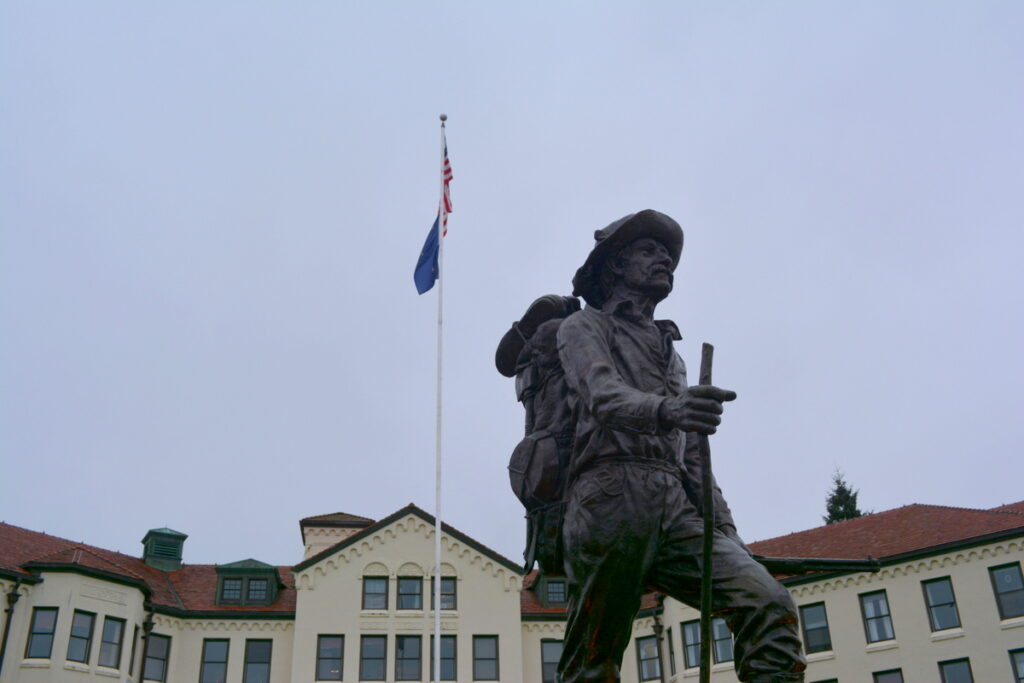

In the 1920s, Seattle sculptor Alonzo Victor Lewis undertook a monument honoring the men who ventured north during the gold-rush era. An earlier model was based on George Washington Carmack, but Lewis and the sponsoring Alaska Yukon Pioneers disliked its expression. They chose Fonda to pose for a new face. Lewis replaced the original head with Fonda’s likeness on the full-size model.
The project languished for years because the sponsors could not raise the necessary funds. Fonda died in Seattle on August 31, 1938, following an illness described in a hometown obituary as a ruptured appendix. He was eighty. His obituary in The New York Times accurately connected him with Lewis’s “Sourdough” sculpture but mistakenly placed a towering completed statue at the Washington State Capitol in Olympia.
The bronze monument, ultimately named The Prospector, was actually dedicated on October 18, 1949, at the Sitka Pioneers’ Home. Cast by Roman Bronze Works in New York, the 13½-foot figure depicts a fully equipped frontier prospector, looking toward the horizon. Fonda’s widow, Lucy, attended the ceremony; sculptor Lewis had died three years earlier. A smaller related work titled The Sourdough is associated with the Klondike Gold Rush National Historical Park in Seattle.
A Fonda Legacy in Bronze
Photographs of Clark show the mustache and weathered face that appear in Lewis’s sculpture. Nearly ninety years after his death, William Clark Fonda’s adventures remain a mixture of documented journeys and enduring frontier legend. But one fact is secure: an American pioneer who began life in the Mohawk Valley supplied the face of a monument celebrating Alaska’s gold-rush generation.
Sources and further reading
- Alaska Office of History and Archaeology, Pioneers’ Home & Totem Square Historic Structures Report (2017), pp. 49–57.
- National Park Service, Golden Places: The History of Alaska-Yukon Mining, Chapter 11.
- The Alaska-Yukon Gold Book (1930), p. 87.
- The New York Times, September 1, 1938; Amsterdam Evening Recorder, September 8, 1938; Leader-Republican, September 10, 1938 (family archive copies).
- Fonda family genealogy and image collection.